
The Concept of Mosquito-Free Parks: Solving a Global Outdoor Pest Challenge
Beautiful parks and gardens are designed for relaxation — but mosquitoes ruin the experience. Discover how the mosquito-free park concept uses multi-level physical pest control to reclaim outdoor spaces.
Beautiful parks and residential gardens are designed for people to relax, gather and enjoy nature. Well-planned green spaces feature lush plants, winding paths, soft lighting and comfortable seating areas. Yet there is a universal problem that ruins this perfect outdoor experience: flying insects, especially mosquitoes. Even with thoughtful landscape design, these spaces often become uninhabitable once mosquito activity picks up. Adults struggle with itchy bites, and young children suffer far more when exposed outdoors.
This is not a local issue, but a worldwide challenge. Parks and community green areas almost always contain water sources, such as streams, ponds, damp soil and shaded humid corners. These are ideal breeding grounds for mosquitoes. Mosquitoes have coexisted with humans for thousands of years. Their reproduction cycle is fast, and they spread easily across open outdoor environments. It is impossible to fully eliminate all mosquitoes in an open-air green space. Chemical spraying can reduce pest numbers temporarily, but new mosquitoes will keep migrating in from surrounding areas day after day. No outdoor site can achieve a state with zero mosquitoes.
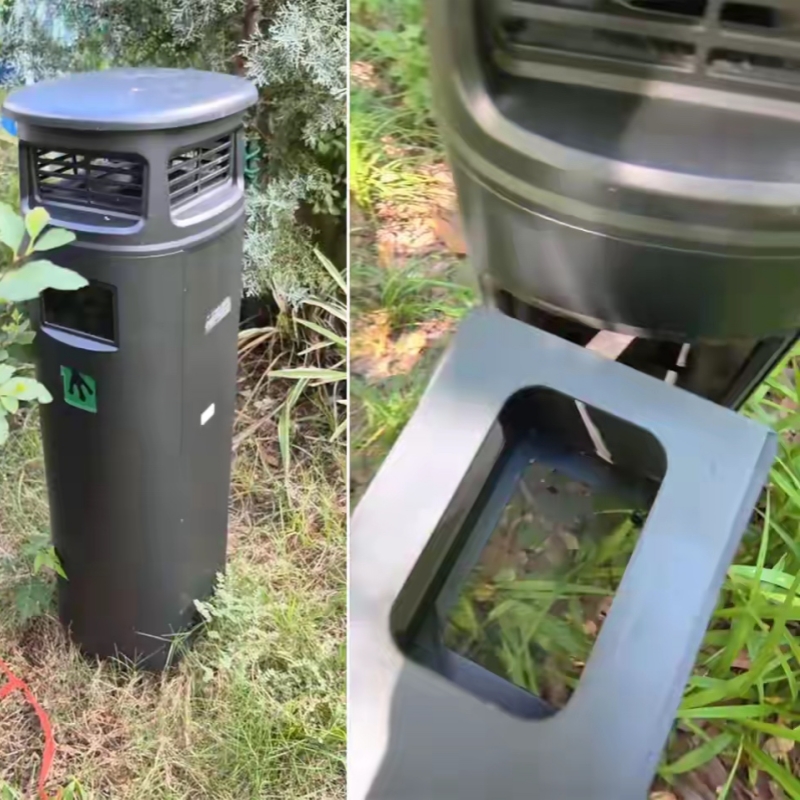 ▲ The mosquito-free park concept in action — layered physical pest control devices in public green spaces
What "Mosquito-Free" Really Means
This is where the "mosquito-free park" concept comes in. Many people misunderstand this term, thinking it means there will not be a single mosquito left. In reality, a mosquito-free park does not promise complete eradication of insects. Instead, it aims to suppress mosquito populations to a low enough level that people can stay outdoors comfortably, without constant biting and disturbance. Visitors can sit on benches, take walks, or organise family activities in the park without worrying about mosquito bites.
The "mosquito-free park" project in Hangzhou, China, has attracted global attention. The project deployed outdoor physical pest trapping devices across the public green space. Some of these traps were reported to capture tens of thousands of flying insects each day. The project sparked discussion among the public. Some questioned the real-world effect of the equipment, while others recognised the value of trying new physical pest control methods in public spaces. The core idea behind the trial was to reduce pest pressure in an open green area, creating a more pleasant public environment for residents.
Hong Kong has also explored similar community mosquito reduction projects. Authorities installed outdoor trapping equipment in public parks to cut down local mosquito populations. More cities around the world are starting to explore this model. Residential compounds, large community gardens and public recreation zones are gradually adopting layered physical pest management systems. Instead of relying heavily on chemical pesticides, these projects combine multiple physical trapping devices to build a multi-level pest control network.
Applying the Concept to Private Gardens
For private residential yards, home owners face the exact same headache. Many families invest time and money to build beautiful backyards for evening barbecues, casual chats and family gatherings. However, heavy mosquito activity stops people from enjoying these outdoor spaces. As with public parks, home gardens have damp soil, plant beds and shaded spots, which support mosquito breeding. Spraying pesticides repeatedly brings concerns about chemical residues, especially for families with kids and pets. Physical trapping solutions become a safer alternative for private outdoor spaces.
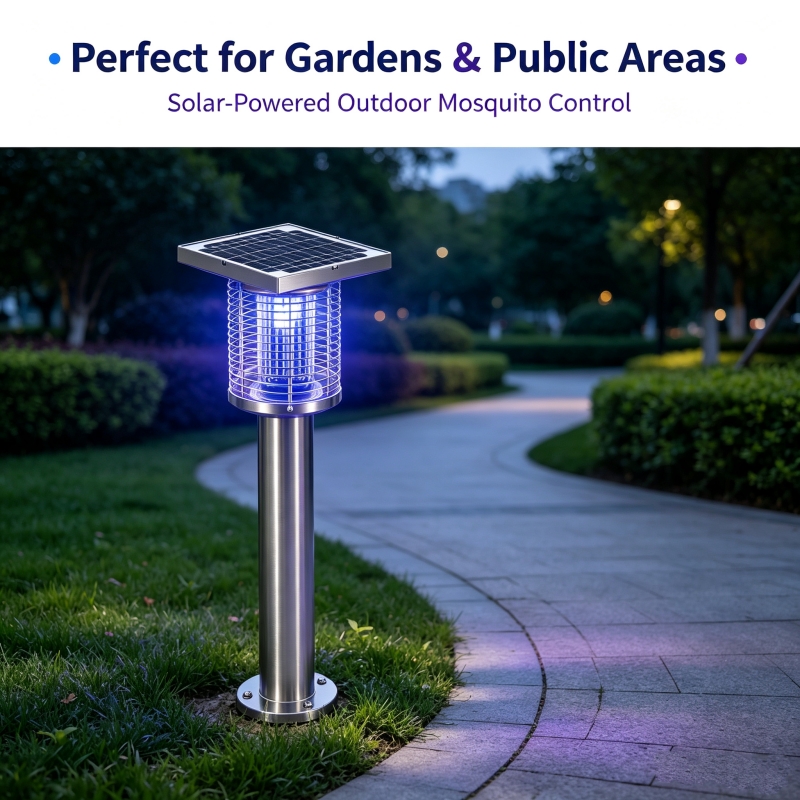 ▲ Layered physical pest control in action — solar electric mosquito trap 050C
Multi-Layered Physical Pest Control: The Core Technology
Multi-layered physical pest control systems are the core technology supporting mosquito-free park projects. Different types of devices work at different heights and positions within the landscape. High-mounted solar-powered light traps target moths and flying insects that move in the upper air space. Ground-placed traps handle mosquitoes and low-flying pests close to plants and lawns. These devices work together to intercept flying insects across different vertical zones of the green space. Since they work through physical trapping, they do not release chemical pesticides into the environment. This fits the growing global demand for eco-friendly pest management for public and residential green areas.
Of course, these physical devices cannot wipe out all pests in open environments. Open parks and large gardens are connected to the wider natural ecosystem. Insects will keep moving in from surrounding areas. What the system can deliver is continuous population suppression. It brings pest numbers down to a tolerable threshold, so humans and nature can coexist comfortably. This is the real value of the mosquito-free park concept.
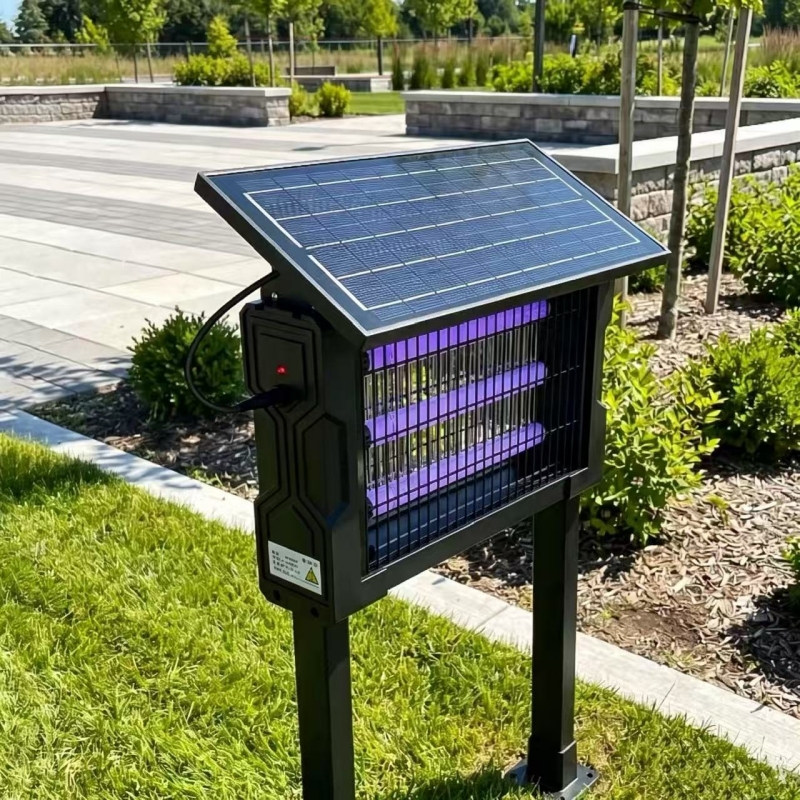 ▲ For larger yards and community gardens — 35W commercial solar mosquito killer
Physical Trapping vs. Chemical Spraying
Traditional pest control for public green spaces mostly depends on chemical spray services. Teams come periodically to spray insecticide across bushes and wet zones. This method gives short-term results, but it has clear downsides. Chemicals may affect beneficial insects, and repeated spraying raises health concerns for families visiting the park. Physical trapping infrastructure operates continuously day and night, offering long-term pest suppression with fewer chemical inputs. For landscape contractors, PCO service providers and municipal park managers, this approach is becoming an important alternative solution.
The idea of mosquito-free public spaces is no longer just a theoretical vision. It is being tested and improved through real-world projects across different regions. As physical trapping technology continues to upgrade, layered pest control solutions are finding wider use in city parks, community landscapes and private home gardens. The goal remains simple: to let people fully enjoy outdoor green spaces again. Whether you are visiting a city park or relaxing in your own backyard, you can sit outside, chat and spend time with your family without being troubled by mosquitoes.
Build a Mosquito-Free Park or Garden
Tell us your site type, acreage and pest pressure. We will help you match high-level, mid-height, ground and monitoring tools into a custom layered solution. OEM/ODM available.