
From Pest Control to Understanding Nature: Building a Future for Harmonious Natural Spaces
AI pest monitoring is helping physical pest control move toward smarter natural spaces, connecting pest data, solar-powered devices and ecological understanding.
For thousands of years, human beings have learned to understand the natural world by observing it.
We watched the seasons change, followed the movement of insects and birds, learned how crops responded to weather, and gradually developed agriculture, cities and modern civilization around these observations.
Today, technology gives us a new ability.
Sensors can collect information. Cameras can observe changes. Solar energy can power equipment in remote environments. And artificial intelligence can help humans recognize patterns in enormous amounts of data.
But technology itself is not the destination.
At Peizhi Trading, we believe technology should help people understand the natural environment better — and make better decisions while maintaining a healthier balance between human activity and nature.
This is the idea behind our emerging vision of spatial physical pest management.
It begins with something very practical: physical pest control.
And it may eventually become something much larger.
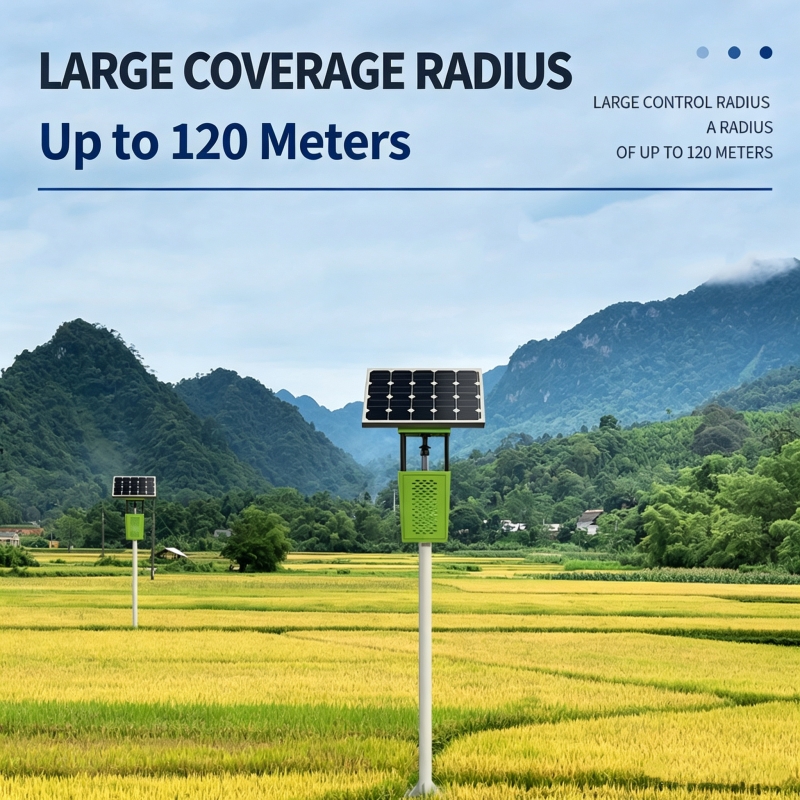 ▲ AI pest monitoring helps connect observation, data and ecological understanding
From Individual Pest Traps to a Spatial System
Traditional pest control often focuses on one question:
"How do we eliminate pests?"
Our thinking is gradually moving toward a different question:
"Where are pests appearing, why are they appearing, how are populations changing, and how should physical control be deployed within a larger environment?"
That difference is important.
A vineyard is not simply a collection of grapevines.
An orchard is not simply an agricultural production area.
A municipal park, wetland park, ecological garden or residential green space is a living environment in which insects, plants, weather, water, soil, sunlight, human activity and seasonal changes continuously interact.
Physical pest control therefore should not exist as an isolated device.
It can become one layer within a broader spatial management system.
 ▲ Solar-powered physical control as one practical layer within a spatial system
Our Solar Wind Suction Insect Killer Lamp is a good example of this direction.
It combines an insect-attracting light spectrum with negative-pressure suction and physical trapping, while using solar charging for outdoor deployment. The available models can also incorporate 4G IoT functions, including remote management and data uploading.
Today, this is already a real product.
Tomorrow, equipment like this can become a physical node within a larger environmental network.
The important change is not simply adding more hardware.
It is connecting hardware, location, observation and environmental information together.
From Counting Insects to Reading the Environment
Imagine a large orchard.
Instead of manually checking every area, a distributed system could gradually collect information from different locations and heights.
Some points could monitor flying insects.
Others could observe pest activity closer to crops.
Additional environmental information could eventually include temperature, humidity, rainfall, wind conditions, seasonal changes and vegetation conditions.
Over time, these observations could form a spatial picture.
Not simply:
"There are insects here."
But:
"In this area, insect activity is increasing under these environmental conditions, while another area remains relatively stable."
That is where AI becomes meaningful.
AI does not replace human understanding.
It becomes a tool that helps humans see relationships that are difficult to observe manually.
The system can assist with pattern recognition, comparison, trend analysis and early warning.
The final objective is not to create an artificial world.
It is to help us understand the real world more clearly.
Physical Trapping Can Become Environmental Data
A physical trap can therefore have two functions.
The first is obvious:
Control.
The second is more interesting:
Observation.
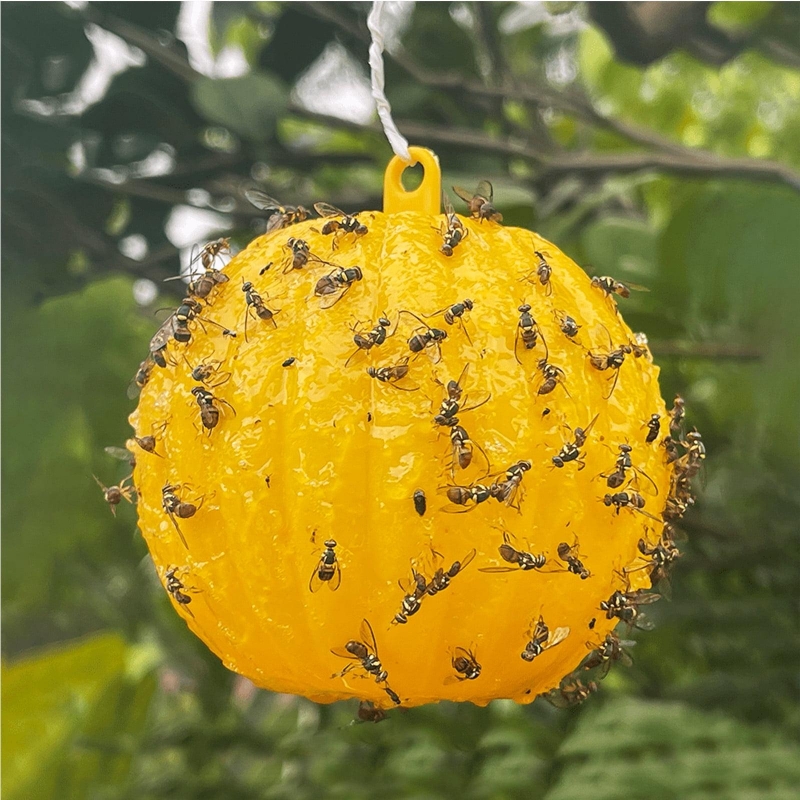
Consider an orchard sticky ball trap.
Our Orchard Sticky Ball Trap uses shape, color and fruit-related attraction to physically capture and monitor orchard pests. It is designed for applications including orchards, citrus groves, mango farms, vineyards, tea gardens and organic farms.
Today, a grower may simply inspect the trap and determine whether pest pressure is increasing.
In a future spatial monitoring system, the same physical observation could become part of a larger dataset.
Different locations. Different dates. Different seasons. Different crops. Different weather conditions. Different pest populations.
When enough observations accumulate, the system can begin to reveal relationships that were previously scattered across individual farms and individual experiences.
This is where a simple physical product can become part of something much larger.
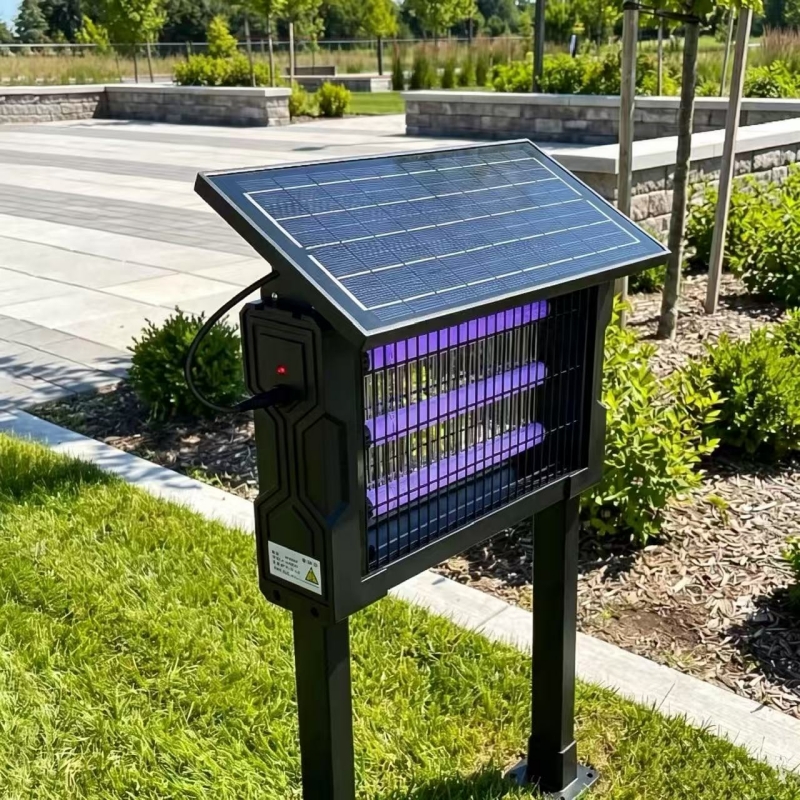 ▲ Public spaces like parks, wetlands and community gardens benefit from spatial monitoring
The Same Idea Can Extend into Public Spaces
The future of physical pest management is not limited to agriculture.
Consider a city park. A wetland park. A community garden. A botanical garden. A resort. A large public green space.
These environments also contain complex ecological relationships.
People want these spaces to be comfortable and safe, but they also want them to remain natural.
The challenge is therefore not simply to eliminate every insect.
That would be neither realistic nor desirable.
The goal should be to understand which pests require intervention, where intervention is appropriate, when intervention is necessary, and how intervention can be as targeted as possible.
Solar-powered equipment can provide a practical physical-control layer without requiring extensive electrical infrastructure.
Our 35W Commercial Solar Mosquito Killer is designed for large outdoor applications including farms, orchards, ecological parks and public green spaces. It uses solar charging, physical insect elimination and weather-resistant outdoor construction.
Again, the product exists today.
The larger system is the direction we are developing toward.
AI Is a Tool — Human Understanding Is the Purpose
We do not believe AI should be presented as the answer to everything.
AI is a tool.
Its value depends on the quality of the information humans collect, the questions humans ask, and the decisions humans ultimately make.
For natural environments, this principle becomes even more important.
A future system could gradually connect:
Physical Trapping → Monitoring → Environmental Data → Spatial Mapping → AI Analysis → Human Decision → Targeted Intervention
This creates a continuous feedback loop.
The environment changes. The system observes. Data accumulates. Patterns become clearer. Humans make decisions. Physical devices respond. And the environment is observed again.
It is not about creating a machine that controls nature.
It is about creating better tools for humans to understand nature and coexist with it.
From Pest Control Toward a New Understanding of Natural Space
This is why our newly developed direction, AI Pest Monitoring, is important to us.
It represents an early step toward connecting existing physical pest-control hardware with more structured monitoring, spatial information and future AI-assisted analysis.
The system is not yet a complete meteorological or environmental monitoring platform.
And we do not intend to claim that it is.
There is still substantial work ahead: more pest data, more environmental parameters, better spatial deployment models, stronger data analysis, and more detailed engineering applications.
But the direction is clear.
We already have physical products. We already have practical application scenarios. We already have early monitoring capabilities.
Now we are gradually connecting these pieces.
A Vision Beyond Pest Control
In the future, such systems could potentially support agriculture, vineyards, resorts, municipal parks, wetland parks, ecological restoration projects and community green spaces.
They could also create opportunities for scientific education and environmental observation.
Imagine children visiting a wetland park and seeing how insect populations change with seasons.
Imagine students observing relationships between weather, vegetation and insects.
Imagine researchers using long-term field observations to better understand local ecological changes.
Imagine a city gradually building a clearer picture of its natural spaces — not just through satellite images or weather stations, but through many small observations happening close to the ground.
That is a very different vision of technology.
Technology does not stand above nature.
It helps us look more carefully at nature.
Building What Is Useful Today — Preparing for What Comes Tomorrow
Peizhi Trading remains a practical B2B supplier of physical pest trapping products.
Our business today is real: adhesives, traps, solar equipment, physical pest-control products, OEM/ODM development, supply-chain integration and international export.
The future direction does not replace this foundation.
It grows from it.
We believe the most meaningful innovation often begins with something simple and useful.
A trap. A sensor. A solar-powered device. A camera. A data point.
Then another. And another.
Until these individual elements begin to form a picture.
A picture of how pests move. How seasons change. How environments respond. And how human beings can make better decisions within the natural world.
Perhaps the ultimate destination is not simply better pest control.
Perhaps it is a better understanding of the spaces in which we live.
From pest control, toward understanding nature.
From isolated products, toward connected spatial systems.
From technology as an end, toward technology as a way for humanity to better understand the natural world.
That is the future we are beginning to explore.
And we believe it is a future worth building — carefully, practically, and together.
Explore the Future of Pest Management
Whether you need physical traps, solar-powered equipment, or a complete spatial monitoring system, we offer wholesale and project-level cooperation for agriculture, public spaces and ecological projects worldwide.